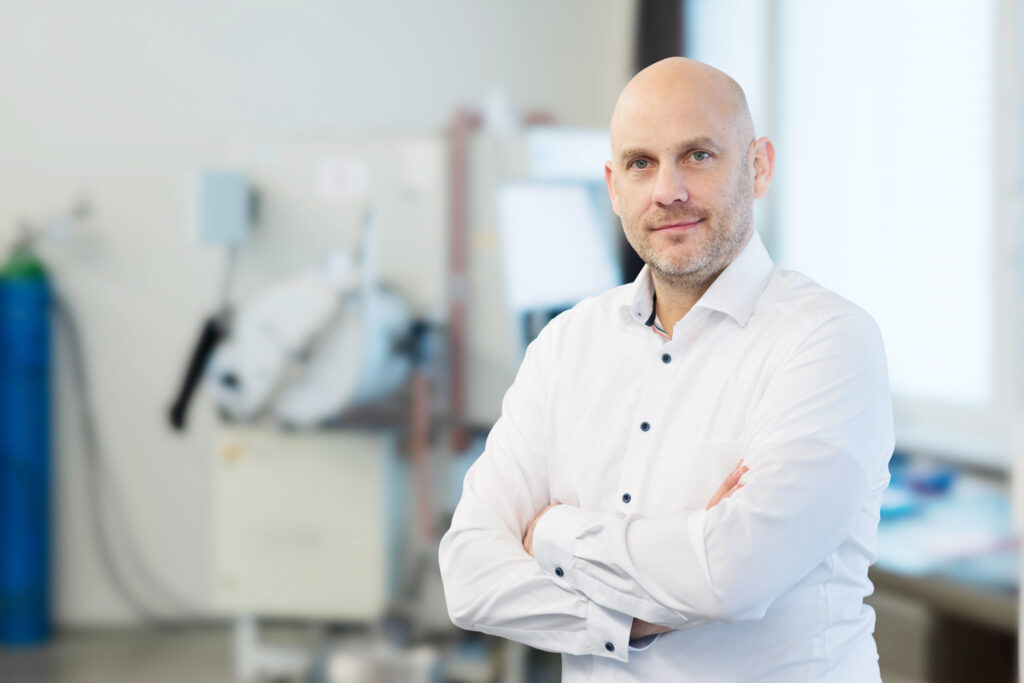
Photo © European Innovation Council
Read the German versionMr. Scheffer, you are deliberately advocating stronger funding in order to bring European projects of the future into focus, both broadly and in a targeted way. Why is the battery industry so important to you?
Over the past three decades, I have had many opportunities to connect with entrepreneurs from a wide range of industries, to get to know their visions and explore their potential. What has always mattered to me is understand what will make Europe valuable in international markets in the decades ahead. The automotive industry is one of our key industries and is at risk of losing its leadership position on an international scale. The development and production of battery cells and battery modules play an immensely important role in this. In electric vehicles, the battery is taking over the role that the powertrain block used to have in combustion-engine vehicles. That was one of Europe’s competitive advantages. We need to regain that position in batteries, and I am convinced that this can indeed be achieved with European capabilities and opportunities. There must be no shortage of the necessary decisions and resources. That is what I am committed to.
You have a remarkable network in the world of research and innovation, and since 2000 you have also been founder and CEO of Polisema BV, which acts as an adviser and investor for start-ups, including in the field of energy storage. What must we do to tap into this network and benefit from it?
I think many entrepreneurs are simply not aware of the opportunities available at the European level. In any case, it is well worth looking into them and making use of existing national networks. The EU has long recognized that the battery industry can only be successfully developed at the European level, rather than solely at the national level as in the past. The importance of energy storage, not only in the automotive sector, is immense for renewable energy, and in fact we are still only at the very beginning here. That is why the opportunites for European funding in research, production, and all related sectors will continue to expand. We all need to communicate this much more strongly and promote it more actively.
Could you explain how EIC funding works, especially in relation to the funding opportunities offered by the ERC, and what this means for the practical implementation of research results?
The European Innovation Council, or EIC, is designed to help move ideas from the laboratory towards real-world innovation and market uptake. It offers three main funding schemes along different stages of technological maturity: Pathfinder for early-stage research at low technology readiness levels, typically TRL 1 to 3/4, Transition for maturing results towards proof of concept, validation, and early business planning, usually from TRL 4 to 6, and Accelerator for later-stage innovation and scale-up, from TRL 6 to 8/9. The Accelerator is specifically aimed at SMEs, so projects can, for example, progress from Transition funding into the creation or growth of an SME and continue their development there.
This is where the connection to the European Research Council, or ERC, becomes particularly relevant. ERC funding sits within the excellence-driven part of Horizon Europe and primarily supports frontier research. In that context, the ERC Proof of Concept grant is especially important, because it allows researchers to explore whether their scientific results could have practical or industrial applications. If that potential can be demonstrated, it can create a strong bridge towards the EIC.
In practice, this means that researchers can move from the excellence pillar to the innovation pillar of Horizon Europe. Strong results from ERC-funded research, especially when supported by ERC Proof of Concept funding (PoC), can help applicants build a compelling case for EIC support, in some cases even allowing them to apply directly for the Transition stage. More broadly, Horizon Europe funding can help projects generate the evidence needed to demonstrate implementation potential, which is increasingly central under the current system.This marks an important shift from earlier programmes such as FET Open (Future Emerging Technologies), which often funded highly ambitious research without a clear route to deployment. With the EIC, the emphasis is much stronger on implementation, societal benefit, and the potential to bring innovation to market. Researchers are therefore encouraged to think about impact and application.
You are also a highly respected regional politician and, as Regional Minister in Gelderland, have done a great deal for young and innovative companies. Today, you lead the European Innovation Council and can therefore draw on your experience in business while also providing valuable input that helps advance European economic and research policy. What do you hope for from us, from associations, networks, project teams, and from young companies that recognise and accept this challenge?
I think many politicians are still not fully aware of the scale of the task ahead if we want to move forward successfully in future energy storage. Without effective and smart storage technologies, the transition to renewable energy cannot be fully successful. But there is no serious alternative to it. That is why we must all contribute together. We must succeed together in ensuring that even the last politician, especially at the European level, understands how important targeted and sustained support for the battery industry really is. What matters here is to guide ideas and companies all the way to successful market readiness, rather than merely offering start-up funding.
You have now worked with more than 20 universities and over 200 partners in the EU on major R&D projects and are the author of more than 100 publications. What advice would you give to TraWeBa members?
From my perspective, TraWeBa is already a well-functioning network operating throughout Germany, with contacts across Europe and in the European Parliament. I have also noticed that networking with researchers and developers is very well integrated. With TraWeBa, it should be possible, and indeed necessary, to advance the implementation of the battery industry for both the automotive sector and the energy industry.
A transformation of this scale requires a holistic approach. Battery makers need an innovation push, but they also need a regulatory environment that enables new solutions to scale. Once the innovation is ready, regulation and market design must support its uptake. If Europe wants to develop new battery technologies successfully, the effort cannot be purely technological; it must also include regulation and industrial policy.
We need to help companies develop batteries with lower dependence on critical raw materials and chemistries that can reduce costs. At the same time, policy tools should support and incentivise European producers to close the cost gap, especially by bringing down the production cost. Sodium-based batteries may also be worth watching in this context, as they could be reducing the dependence on critical raw material.In short, if Europe wants to compete more effectively in EV batteries, it will need a stronger regulatory and industrial framework, lower production costs (e.g. VAT reductions), incentives for alternative chemistries and a level playing field in global competition. Taxation, non-wage labour costs, and tariffs are key policy levers that deserve closer attention.
Do you have any advice for innovators and entrepreneurs, especially with regard to scalability?
Pricing and market fit are important considerations that researchers and innovators should address early on. If there is no viable market for the end product, it is difficult to justify pursuing it, whether to investors or to public funding bodies.
Innovators entering the battery market may benefit from starting with a niche segment in which competition is less intense, allowing them to bring an innovation to market before moving into larger applications. One possible avenue is dual-use technologies, where a successful defence-related application may later open up civilian business opportunities (e.g. GPS). Regional innovators generally face less competition from abroad in those markets. Another potential niche is aerospace, where cost constraints are often less stringent than in mass-market applications.
As for the start-ups, the success rate in scaling up is low, largely because many SMEs have limited experience with industrial scale-up. One possible way to improve outcomes is to connect SMEs with technological platforms, whether public or company-based that have skilled operators and existing infrastructure.
Such a model could help SMEs develop pilot lines more efficiently, reduce costs and risks, and avoid duplicating investments in facilities that already exist.
This could create valuable partnerships between automotive suppliers with scale-up expertise and SMEs working on novel battery chemistries.The cluster Tecnologico Nazionale Fabbrica Intellingente in Italy offers a similar model.
Do you have advice for companies that are themselves undergoing transformation and are committed to the field of energy storage?
Compared with batteries for electric vehicles, long-duration energy storage (LDES) offers more room to manoeuvre. Innovators and companies considering entry into the battery value chain should therefore also look at this area. LDES is a fast-growing field, not least because of the current geopolitical situation and the role such systems can play in delivering decarbonised energy at a lower cost and with greater grid stability.
At present, the market is clearly signalling demand for mid- to long-duration-storage solutions, but the regulatory framework and incentives for first adopters are not yet fully in place. At the same time, no single technological solution has yet emerged as dominant. This gives Europe an opportunity to take a leading role, especially given the number of promising SMEs in this field. There is a currently an EIC Accelerator Challenge that includes advanced materials for renewable energy and mid- to long-term energy storage, which shows how timely this topic has become.
In this context, one more question about the European Commission’s Directorate-General for Research and Innovation: what exactly should we understand by this?
The European Commission’s Directorate-General for Research and Innovation develops research and innovation policies for the European Union and implements them together with its associated agencies. It oversees the current EU funding programme for research and innovation, Horizon Europe, as well as the EU Missions. This Directorate-General is responsible for EU policy in the fields of research, science, and innovation, with the aim of creating growth and jobs along the entire Technology Readiness Level chain and, in cooperation with sector-specific Directorates-General, addressing our greatest societal challenges. In this way, it is the decisive lever for making the needs and requirements of the battery sector visible and for generating projects and funding-related decisions at the European level in a targeted manner. This is exactly where our work begins, and this is precisely where I see our shared opportunity: to restore Europe’s automotive and battery industries to the global leadership position they rightfully deserve.
Dear Mr. Scheffer, with your words you have given our members and readers another optimistic European perspective on the battery industry. We will continue to carry this European idea forward and encourage more applications for funding opportunities at the European level.
You may read here about the mentioned currently running EIC Call and here about possible avenues to EIC funding.